NO REGRETS – A 440-Mile Journey to Safety After a Lightning Strike
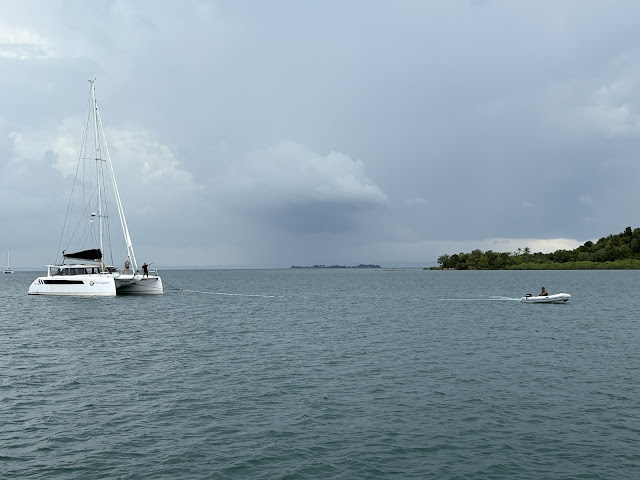
The story below was shared by Khaled and Katrin, crew of the Seawind 1260 NISMA and members of a group of four Seawind catamarans traveling together through the Bangka Belitung region of Indonesia. In the early hours of November 12, during a severe thunderstorm, their companion boat NO REGRETS was struck directly by lightning while all four boats were anchored within 500 meters of each other behind a sandbank. The strike caused a complete failure of NO REGRETS’ engines, electronics and navigation systems, leaving the boat without power in remote waters.
Khaled and Katrin, together with the crews of TOUJAN and NO MORE TEARS, supported Chris and Jo from NO REGRETS through a challenging seven day passage of more than 440 nautical miles. The group faced heavy rain, shifting winds, uncharted channels between small islands and the complex traffic of the Singapore Strait as they worked together to tow and guide the disabled vessel toward safety in Malaysia.
This account is a firsthand reflection of what happened, offering a clear picture of the teamwork, seamanship and resilience that unfolded during an event no one expected but all were prepared to face together.
Struck by Lightning
We were all anchored within 500 metres of each other behind a sandbank on the easternmost part of Bangka Belitung Island. As has been the case for the past few nights, a thunderstorm was passing over us and it was raining heavily when, with a loud bang, the mast of the NO REGRETS was hit by lightning.
Khaled and Khalid from TOUJAN had been awake on our respective catamarans since 4 am, monitoring the wind and our anchor position to ensure the anchors were holding in the 30-knot wind. Khalid was looking out through the windows of his closed front door when he saw a lightning strike hit a mast, with sparks arcing from its top. He thought NISMA had been struck because it was anchored behind his stern and that was the direction he was looking in. When he rushed outside and counted the top lights of the surrounding masts, he realised that it was NO REGRETS that had been struck. Chris confirmed this with the dry response, ‘Yes, we’ve been hit’, on WhatsApp.
On the Facebook page of SAILING NO REGRETS, he describes what happened next. After the loud noise of the lightning strike woke them up, he and Jo rushed upstairs to the salon where they were met with the smell of burning electrics and saw smoke. An inspection of bilges fortunately showed that the lightning hadn’t torn a hole in one of the hulls, so at least there wasn’t any ingress of water. The batteries had disconnected, so they switched them back on – and immediately heard electrical shorting and saw more smoke. Both of the boat’s switching control interfaces had burnt out. These units power almost everything: fridges, freezer, lights, pumps….
Realising that there was nothing they could do there and then, they went back to bed and waited for daylight. Later that morning, the other three skippers helped test the remaining onboard systems to see if anything could be made to work. It turned out that almost all of the B&G electronics were damaged too, meaning there was no chartplotter, autopilot or depth or wind data. As if that weren’t dramatic enough, both engines were also dead on inspection. So were the solar charge controllers. It then dawned on them that, with no engines, no navigation equipment, no charging capabilities and a damaged electrical system, NO REGRETS was effectively crippled — in remote Indonesia.
Over the next few hours, we researched and debated our options. Chris repeatedly talked to SEAWIND, the Australian manufacturer of our catamarans. He made a list of the parts that would need replacing. SEAWIND Vietnam could airfreight some of the parts to Bangka Belitung, the nearest larger island, but they had no extra lithium batteries in stock. Due to high demand, it would take months before they could be shipped in from China. Furthermore, we knew that it was very difficult to get packages from abroad through Indonesian customs and its bureaucratic maze. With no quick fix on the horizon, Chris decided that he would have to make it to Phuket. This would have to be by sailing, since this was the only option left for the poor NO REGRETS.
We were all shell-shocked. The same could have happened to NISMA, TOUJAN or NO MORE TEARS. Given the number of thunderstorms in the region through which we are travelling, it is not unlikely that we could be struck by lightning again within the next three weeks until we reach northern Thailand and exit the bad weather zone. In fact, we know of three other Sail Malaysia Rally boats that have been struck by lightning in this region in the past nine months. There is a 15–20% probability of being hit directly or indirectly, which can cause just as much damage. On our boats, where everything is run by electronics, the effect is devastating, as the case of NO REGRETS has just shown.
Since Chris and Jo had understandably decided they needed to leave, TOUJAN, NO MORE TEARS and NISMA agreed to accompany and assist them.
We understood the challenges that lay ahead. We might have to tow No Regrets for a good three weeks, possibly with the wind against us the whole time, battling currents, thunderstorms and rough seas as we crossed the Singapore and Malacca Straits. If it hadn’t been for Jo and Chris’s experience as skippers — they had seven years of full-time cruising under their belts and had previously been towed by another sailboat from Nouméa to Australia after dismasting their Seawind 1260 — we might have tried to dissuade them and suggested hiring a towing company to move No Regrets to the nearby industrial harbour of Pangkal Pinang, where we could attempt to repair her over the coming months. However, we trusted their judgement, having sailed with them for the past seven months and knowing them not to be reckless adventurers. They are resourceful and level-headed, and they always maintain a positive attitude in the face of adversity. They are also always the first to offer competent technical advice and a helping hand to others. Tony and Margaret on No More Tears had already sailed around Australia, and Toujan brought a strong team spirit and excellent navigation skills to the table. We ourselves felt sufficiently capable of doing our part. We also agreed that, should the rescue operation become too dangerous at any point, we would have to stop towing and ensure our boats were safe.

We left at 2:30 pm on Wednesday, 12 November. A week-long trip (440 nautical miles or 800 km) lay ahead of us to Port Dickson, our first intermediate stop, where we would check in to Malaysia.
The first two days had to be done as an overnight passage as there were no good anchorages to stop for the night and we needed to profit from the favourable wind that was forecast. To make sure NO REGRETS could be seen after dark by other boats, before leaving we decked her out with flashing, battery-operated flares, quite the Christmas tree effect. NO MORE TEARS started towing the hobbled boat out of our anchorage and through the first night, since we were going through a wind-protected channel between two islands. Since we were close to the coast, we had to dodge lots of small fishing boats — not easy when you’re towing another boat. NISMA brought up the rear, since NO REGRETS wasn’t very visible from behind without lights in the back.

The next day, Thursday, 13 November, we had good wind and NO REGRETS started sailing on her own. However, the wind was on the nose with 20 knots and we had to tack, which added precious few miles toward our destination. For the night, NISMA offered to be the pilot boat so that NO REGRETS, which had to be steered by hand after the autopilot was shot by the lightning, could just follow. Katrin remembers NISMA careening up and down the waves during her watch from 7 pm to midnight, with constantly changing wind directions. It was a tense few hours at the helm in the pitch dark, constantly checking instruments, adjusting the course when the wind turned erratically, and looking back to see whether NO REGRETS was following. Margaret and Carri on NO MORE TEARS and TOUJAN, respectively, got seasick from all the slamming. Not ideal, since each boat depends on its crew of two to take turns at the helm, especially at night.
By 6 o’clock the next morning, Friday, 14 November, the wind had died, so we did a tying up manoeuvre and NISMA started towing NO REGRETS.


NISMA continued towing NO REGRETS when we left at daylight the next morning, Saturday, 15 November. In order to save about two hours of passage and have a better chance of making it to our next anchorage before nightfall, we decided to take a shortcut between some small islands, even though they were not charted for depth. TOUJAN once again took the lead and scouted out the passage. Khalid really thrives in his role as the convoy’s pilot, finding good anchor spots, checking them for currents before the rest of us gets there, or making sure there’s sufficient depth and no crazy eddies, like in this case.

We motored until reaching a Noforeignland-recommended anchorage just before sunset. However, shortly before reaching our spot for the night, NO MORE TEARS’ starboard engine started to act up — we later found out that the control of a hydraulic actuating the gear box was defective, most likely as a result of the nearfield effect of the lightning strike that hit NO REGRETS. After we had safely anchored NO REGRETS (an effort involving us dropping the towing line and, depending on the strength of the current, one or two dinghies dragging the boat to a suitable anchor spot, then manually dropping the anchor), Jo and Chris came over to NISMA for dinner — they didn’t have a functioning fridge or freezer anymore and depended on us other two boats to take turns feeding them.

When the engine problem on NO MORE TEARS persisted the next day, Sunday, 16 November, only NSMA was left to tow. We set off again at first daylight, our next destination being a bay named Tanjung Balai, a good 50 nautical miles away. When a squall hit and there was lightning overhead, all of us felt tense….the thunderstorm lasted a good two hours, and on NISMA we disconnected the VHF co-axial cable going to the mast (which was one of the major paths of the lightning that struck NO REGRETS) and put laptops and phones in the oven to create a Faraday cage. Fortunately, this time we all were spared.
Upon reaching the Tanjung Balai anchorage, we had arrived at the starting point for entering Singaporean waters from Indonesia, and were now 200 nautical miles from Port Dickson, Malaysia.
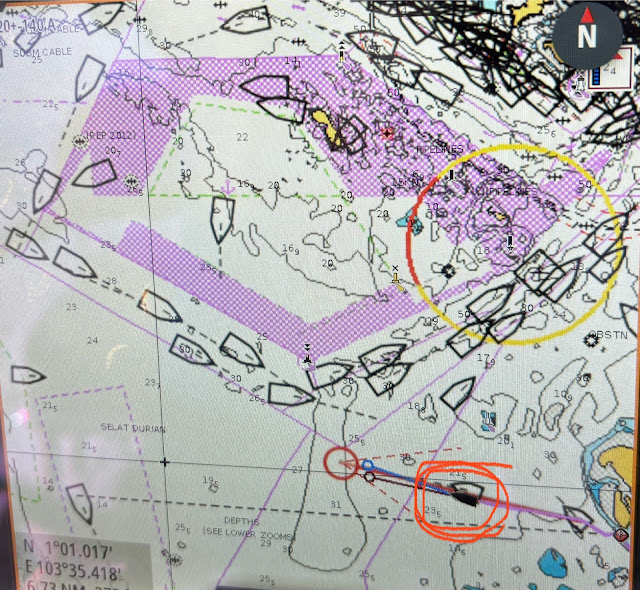
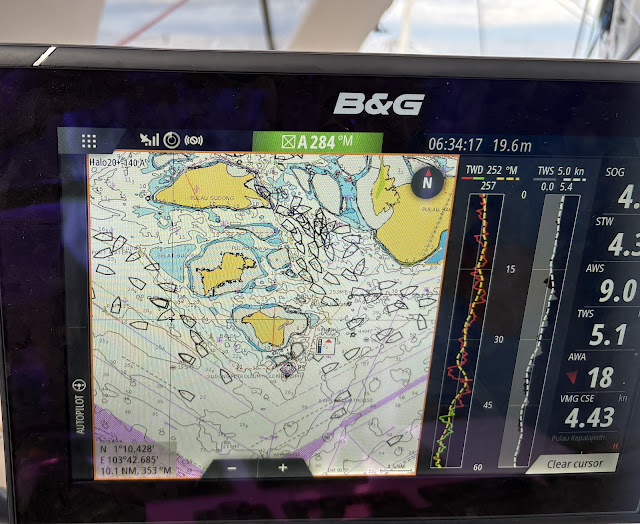
It was now Monday, 17 November, and we were about to enter the Singapore Strait, a short narrow passage at the southeastern end of the Malacca Strait. Together they form the planet’s busiest shipping lane. Most ships traveling between Europe, the Middle East and East Asia pass through this route; 2,000-3,000 ships going through the Singapore strait daily. We’re talking container ships, bulk carriers and oil and gas supertankers, many headed to the Port of Singapore, the word’s busiest port by shipping tonnage.
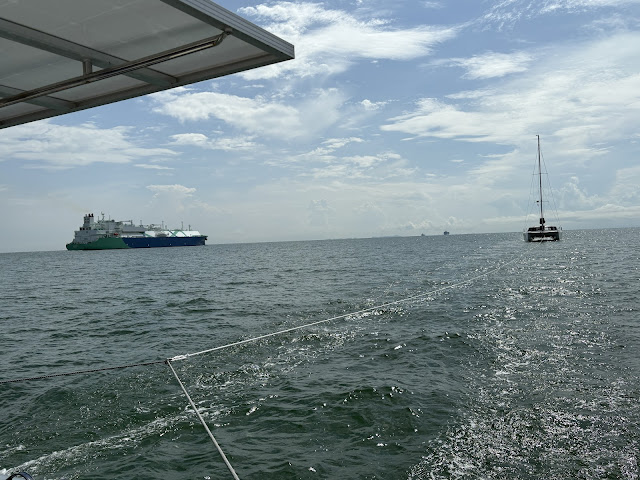
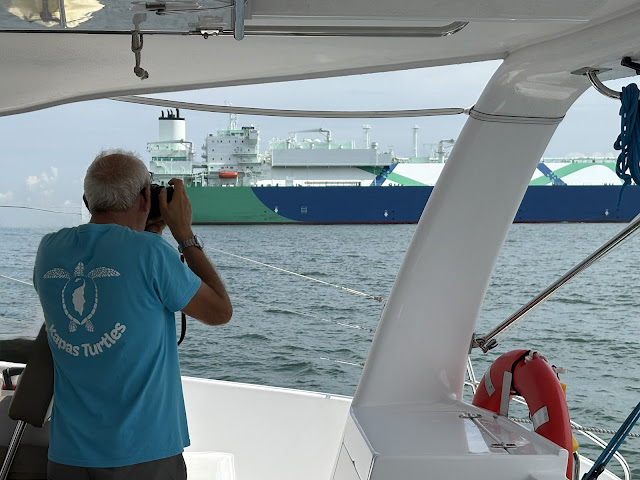
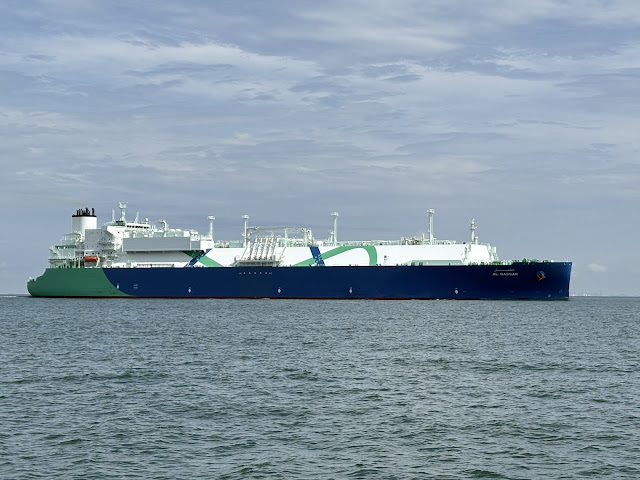
In order to manage the dense and complex flow of vessels, there is a highly organized traffic system, a TSS, which stands for Traffic Separation Scheme. It basically means that there’s a highway with clearly marked lanes in each direction, eastbound and westbound, that all vessels need to stay in. We decided to go along the western edge of the TSS, with traffic against us. In order to get to Port Dickson, we would eventually have to find a gap in the highway’s traffic to cross at a 90 degree angle. With NO REGRETS in tow, NISMA was neither super fast nor super agile, mostly crawling along at 6-7 km per hour. That’s like trying to cross an Autobahn on foot, without running, eyes closed and hoping for the best (ok, not quite, most cargoes don’t go faster than 22 knots, i.e. 40 km per hour. But still, you get the idea). Fortunately, real-time ship tracking and AIS (Automatic Identification System) data are available to us, so we see live positions of the ships and traffic density on our plotter, our radar software constantly calculating distances, speeds and closest point of approach of passing boats. Fortunately also, ships can make radio contact with each other to coordinate their passage. In our case, TOUJAN took on the role of pilot boat, including communicating with cargoes, explaining if needs be that we had an incapacitated sailboat in tow and were not very manoeuvrable. (Imagine the nerve of asking a supertanker to alter its course for our little NO-REGRETS-rescue-convoy). TOUJAN’s task was also to monitor traffic. After some analysis of the ship movements, the best approach seemed to be that we should cross into the median separating eastbound and westbound traffic around 3:00 pm, then stay there until a window opened up to cross the westbound traffic. That window presented itself about two and a half hours later, and we crossed the westbound traffic lane in about half an hour’s time. We made it across just before sunset. Doing this in the dark would have been even more nerve-wracking than it was already.

We arrived in Pulau Pisang on the Malaysian coast a little later and anchored there for the night. We then had a potluck on TOUJAN to celebrate our successful hobbling across!
We now had one last leg to go until Port Dickson: 103 nautical miles in another overnight passage. Our little convoy of four boats left the anchorage at 7:00 am on Tuesday, 18 November. NISMA again had NO REGRETS in tow. Unfortunately, we had the wind on the nose, the waves were choppy and we were slamming again, making life on board very uncomfortable. Just after sunset, another thunderstorm threatened to hit and the wind increased to 25 knots. On top of everything else, we had a current of 2 knots against us, and, despite both engines working very hard, NISMA slogged along at a snail’s pace of only 2.5 NM per hour, dragging NO REGRETS behind.
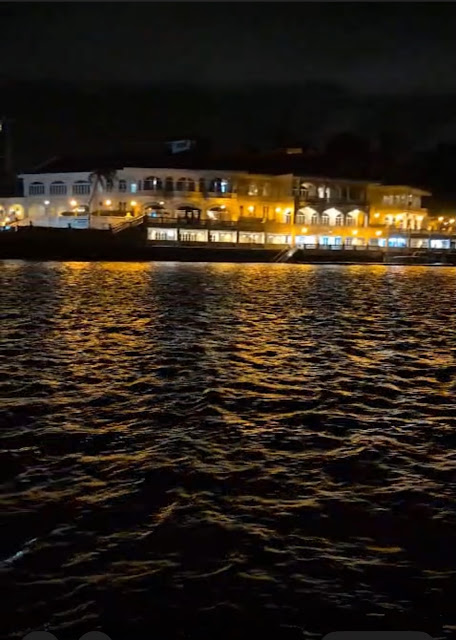
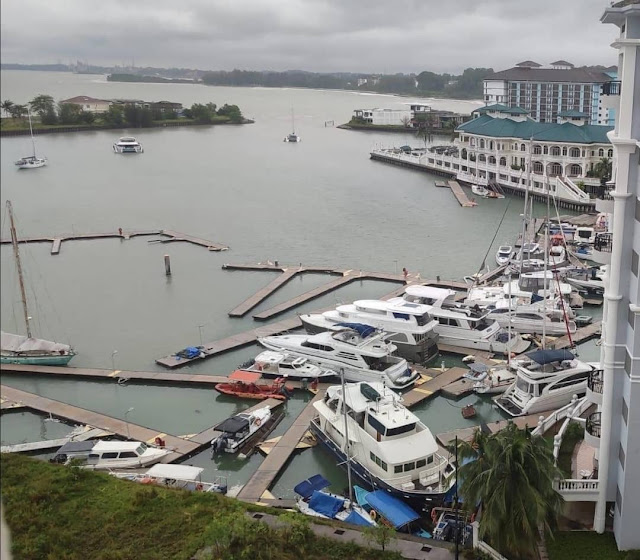
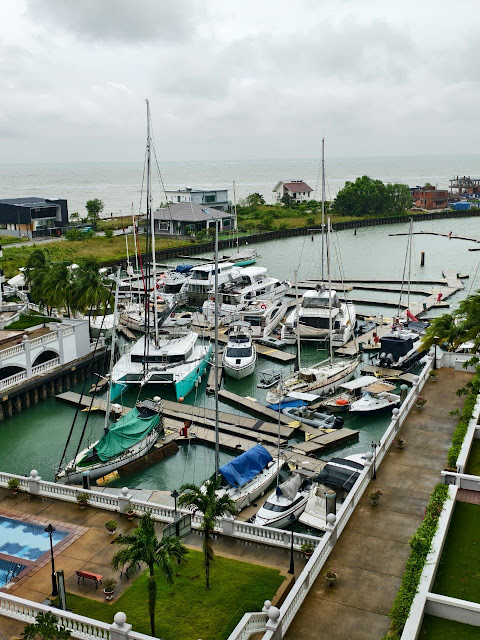
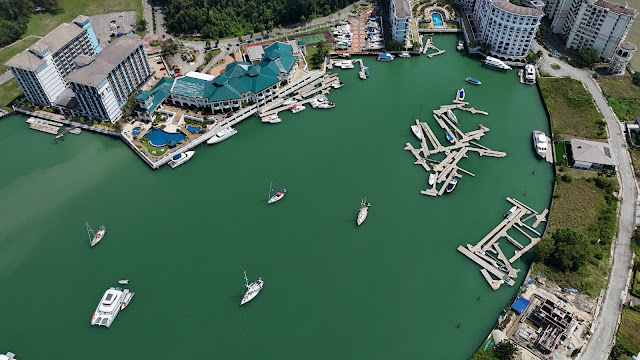
Somehow, we got through the night, taking turns at the helm, but all of us were thoroughly exhausted and only wanted to get to the marina to be protected from this challenging weather, take a hot shower, sleep for 48 hours straight and then exercise our land legs for a change. When we finally entered Admiral Marina in Port Dickson at 11:00 am the next morning, 19 November, a collective sigh could be heard across the four crews.

Despite the stress and the fatigue, we were elated to have conquered the circumstances and together, as a team, made it to a first safe harbour! Of course the hardest job had been that of Chris and Jo, who had to steer by hand when they were’t being towed, had no instruments to navigate, which is especially difficult at night, and practically no food on board aside from crackers and cookies.
In Port Dickson, we enjoyed a few days of rest and did the official checking into Malaysia. All good so far, but we’ve done only half the way to Phuket! The next adventure is just around the corner, so stay tuned!

UPDATE: ADMIRAL MARINA DESTROYED IN CYCLONE

We had left Port Dickson on 25 November and are now in George Town, Penang, about 300 nautical miles north from Admiral Marina. From another cruiser we met in Port Dickson last week, we just learned that in the night from 27th to 28th November, Admiral Marina was completely destroyed in a tropical cyclone, the first ever to make landfall in the western coast of Peninsular Malaysia! On top of 45-50 knots wind, the waves generated by the storm pushed into the marina basin, which is completely exposed to the north, and fatally damaged the piles. The marina structures subsequently gave way. The boat we heard from was able to cut loose their ropes, motor around the floating dock on which they had been attached, and throw their anchor, but it has several holes in their hulls. Apart from two other boats who made it out, all the others are now piled up in one corner of the former marina….Imagine we thought we made it to safety only to be smashed to smithereens in the middle of the night. We had missed it by 2 days….
Where the docks were there is now nothing left.